
ABOUT DARK NUSANTARA
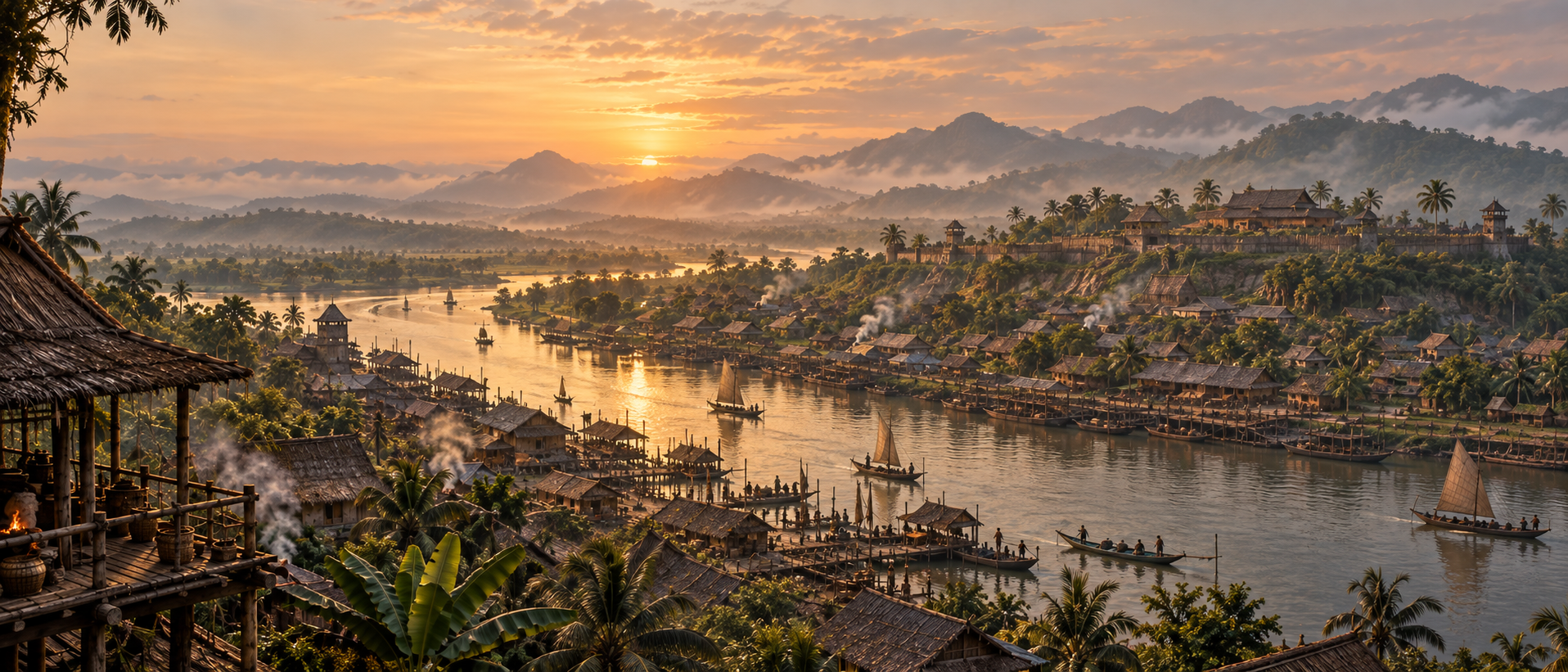
History did not disappear. It became difficult to see.
Dark Nusantara explores the forgotten kingdoms, contested memories, oral traditions and buried histories of the Malay Archipelago.It is a place where documented history, inherited tradition, careful reconstruction and fiction meet—without pretending they are the same thing.From Gangga Nagara and Ganggayu to Beruas and beyond, Dark Nusantara asks a simple question:
What might these worlds have felt like when they were still inhabited, argued over, loved, feared and alive?
How We Read the Past
HISTORY
What the evidence supports
Archaeology, inscriptions, chronicles, material remains, dated records and historical scholarship form the firmest ground beneath everything on this site.History begins with what can actually be supported.
TRADITION
What chronicles and memory preserve
Oral traditions, hikayat, legends, genealogies and local memory may preserve echoes of real places, people and events—but they must be read carefully.Tradition is not automatically fact. Nor is it automatically fiction.
RECONSTRUCTION
What evidence allows us reasonably to imagine
Much of the past survives only in fragments. Reconstruction asks what could plausibly have existed between those fragments: houses, clothing, work routines, river routes, markets, tools, food, political relationships and ordinary lives. The goal is not certainty where certainty does not exist.It is disciplined possibility.
FICTION
Where Lost Thrones of Nusantara begins
The novels go further. They invent people, conversations, private motives and conflicts while remaining anchored to a historically plausible Nusantara world. Fiction allows us to enter spaces where surviving records fall silent—but the boundary should remain visible.
Where History Ends, Reconstruction Begins
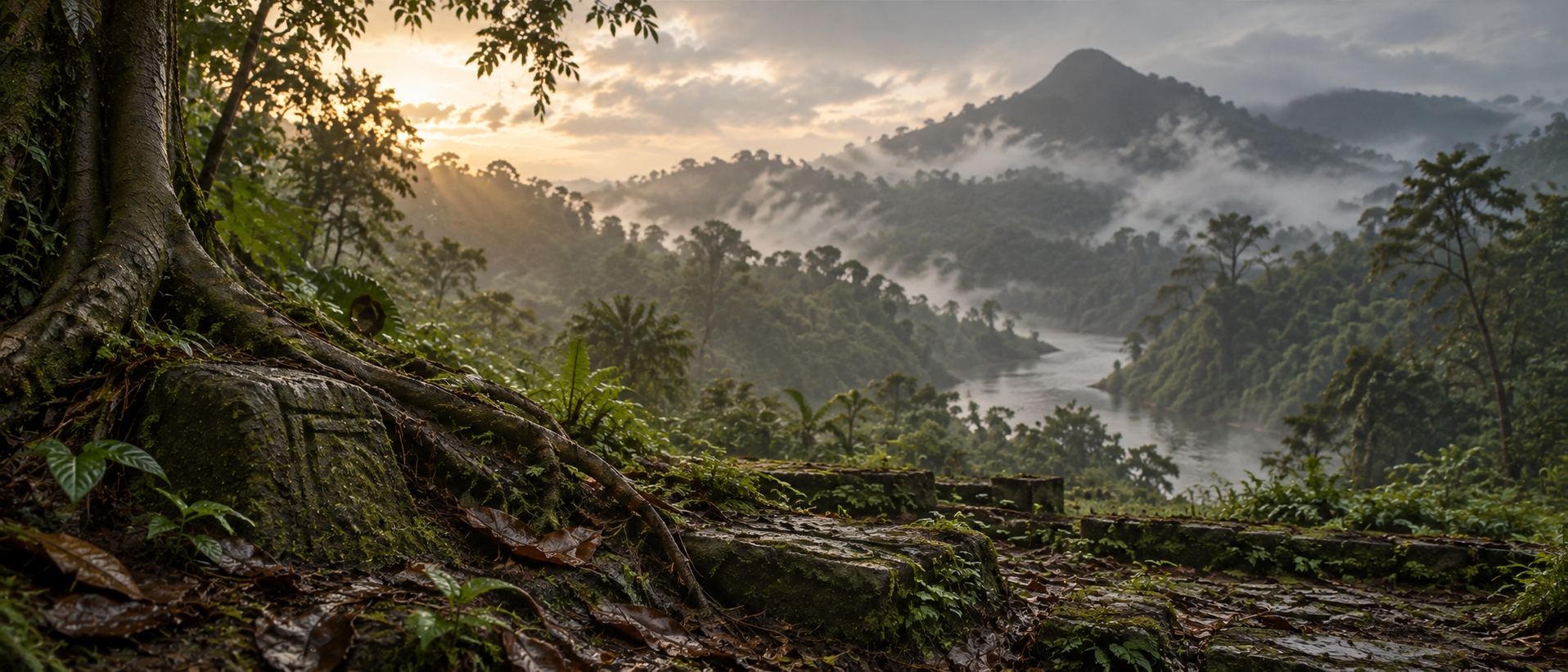
The past rarely survives intact. Sometimes we have inscriptions. Sometimes archaeology. Sometimes foreign chronicles written by outsiders who only saw part of what was happening. Sometimes a place survives only through a name repeated by local communities long after its political centre disappeared. More often, we inherit fragments. A ruined settlement. A river whose course has shifted. An old grave. A trade reference in a distant chronicle. A genealogy copied generations later. A legend that may preserve something real beneath layers of retelling.
Dark Nusantara begins with those fragments. The aim is not to force certainty where the evidence cannot support it. Instead, this project tries to keep several levels of knowledge visible at once.What do we actually know? What survives only through historical tradition? What can reasonably be reconstructed from the environment, material culture, trade patterns and societies of the period? And where does fiction begin? That distinction matters because the most interesting history often lives precisely at the boundary between evidence and absence.
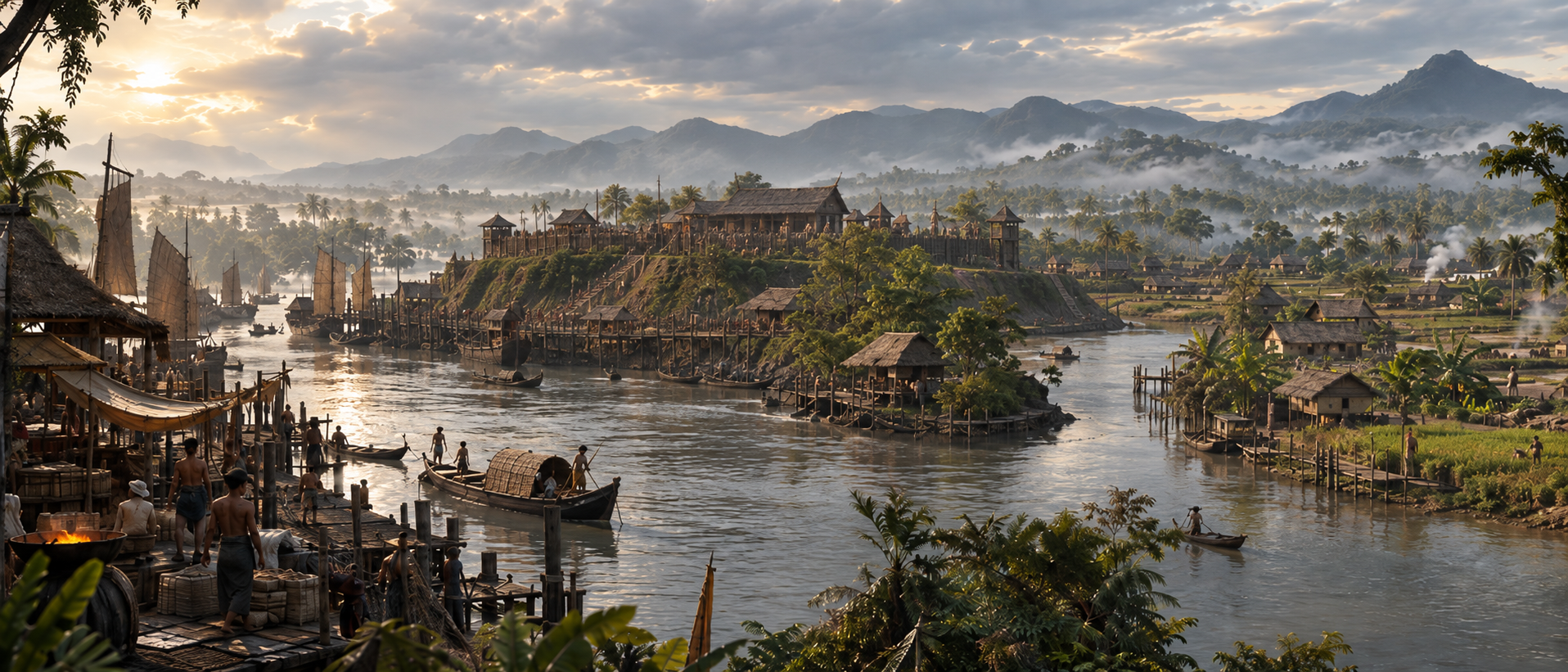
A kingdom such as Gangga Nagara becomes less interesting, not more, if every uncertainty is filled with a confident answer. Sometimes the missing pieces are part of the story. Dark Nusantara therefore treats reconstruction as a discipline rather than permission to invent freely. If a palace is unknown, we do not need a fantasy palace. If clothing is uncertain, we work from fibres, climate, trade, neighbouring cultures and practical use. If a kingdom's political structure survives only imperfectly, we acknowledge the uncertainty rather than hiding it beneath elaborate lore. The objective is not to make the past more spectacular. It is to make it feel possible.
Why Dark Nusantara?
The word dark does not mean horror.
It refers to what lies at the edge of visibility.
Much of early Nusantara history exists in uneven light.
Some kingdoms are well documented for particular periods and nearly silent for others.
Settlements vanish beneath later towns, plantations, rivers, forest and coastal change.
Local traditions remember places that formal histories mention only briefly—or not at all.
That darkness can be frustrating.It is also where historical imagination becomes most necessary.Dark Nusantara is interested in the places where archaeology, memory and landscape refuse to give us a single clean answer.
A weathered stone half-covered by roots.A settlement remembered under several names.A genealogy copied long after the people inside it died.A river route that once connected kingdoms but now appears ordinary.
The project does not try to turn every uncertainty into a mystery.
Instead, it treats uncertainty as part of the historical condition itself.Sometimes the most responsible answer is:We do not know yet.And sometimes that unanswered space is exactly where a story begins.
The Lost Thrones of Nusantara
The fictional heart of Dark Nusantara is Lost Thrones of Nusantara, a connected cycle of historical novels set across kingdoms and communities of the early Malay world.The series begins with places such as Gangga Nagara, moves through Ganggayu, Belukar Sambang, Beruas, Kataha and eventually reaches other centres whose histories overlap through trade, war, migration, marriage, memory and political inheritance. These are not intended as isolated fantasy kingdoms. They occupy the same world. A war in one kingdom creates refugees somewhere else. A smithing tradition survives beyond the fall of the polity that once supported it. A marriage made for political stability can alter a genealogy generations later. A name disappears from one archive and survives in another form somewhere far away. Characters age.
Families fragment.
Techniques travel.
Stories change depending on who preserves them.That continuity is central to the project.The novels therefore follow kingdoms not only at their moments of glory, but through destruction, displacement and transformation.Gangga Nagara is not interesting simply because it may have fallen.It is interesting because people would have survived its fall.They would have carried language, skills, grief, loyalties and unfinished disputes elsewhere.Lost kingdoms do not necessarily vanish when their courts disappear.Sometimes they continue inside other places.That is the larger world these novels explore.
| A kingdom should feel inhabited before it feels legendary.
History From Below
Kings leave names.
Ordinary people usually leave traces.
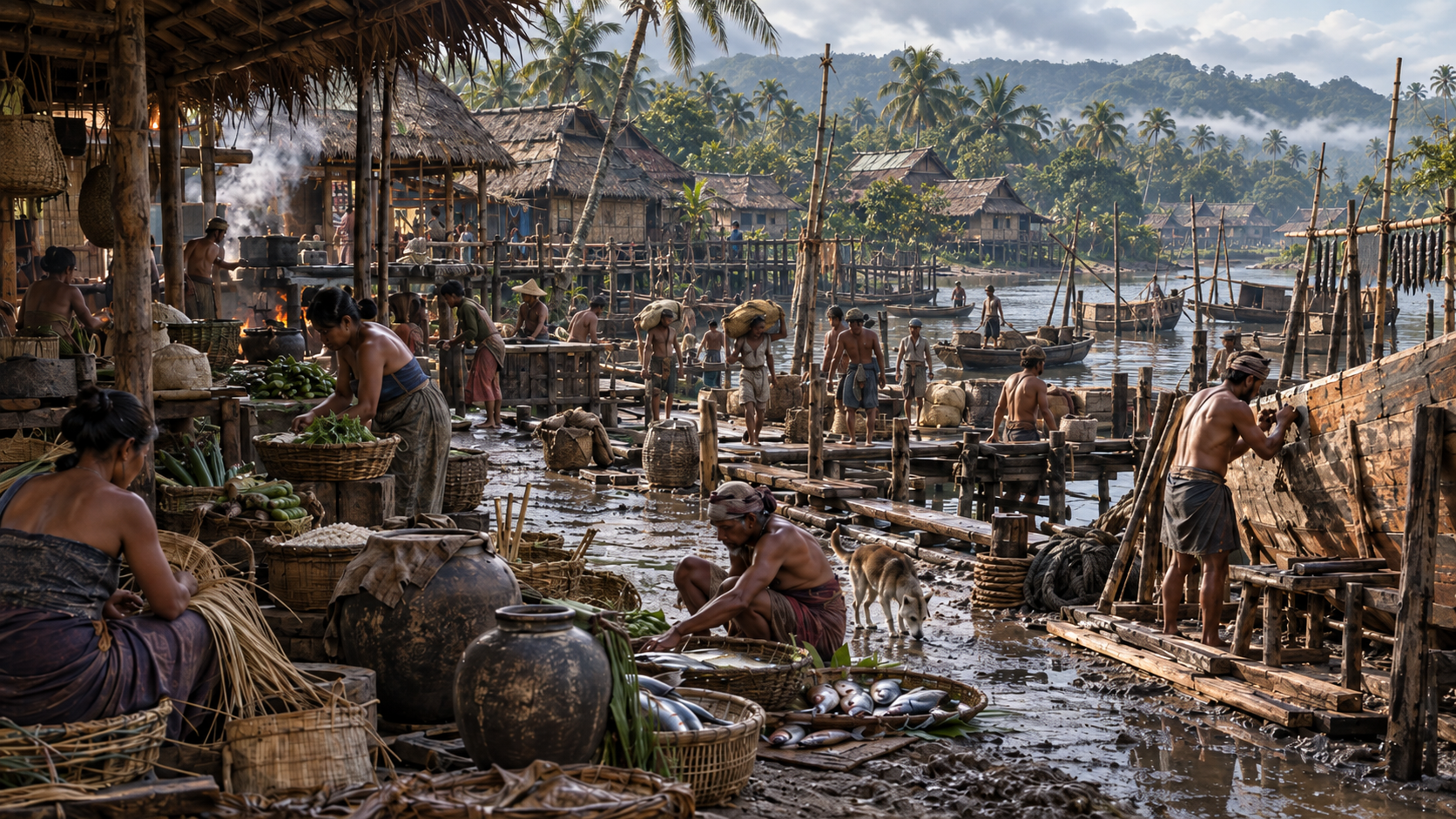
That difference shapes much of Dark Nusantara. Historical reconstruction often gravitates naturally toward rulers, wars, diplomacy and monumental architecture because those are the things most likely to survive in written sources. But kingdoms were not inhabited only by kings. They depended upon boatmen, rice growers, smiths, midwives, traders, fishermen, scribes, healers, textile workers, grave workers, cooks, porters, children, mothers, hunters and people whose names were never carved into stone. So when building the worlds of Dark Nusantara, ordinary life matters as much as political history.
What does breakfast look like beside a river landing after rain?
Who repairs a broken boat?
Where does a midwife keep knowledge that never enters a royal archive?
How far must charcoal travel before it reaches a furnace?
What happens to a woman's property when she marries?
Who washes a body before burial?Who remembers a birth when the official record changes?
These questions are not decorative details. They determine how a society actually works. Food, labour, weather, trade, childcare, clothing, tools, river transport and household disputes should recur naturally because people continue doing ordinary things even when kingdoms are collapsing around them. A siege does not stop someone from cooking. Political intrigue does not eliminate laundry. A royal genealogy may decide who inherits land, but someone still has to plant that land. This is why the visual and fictional worlds of Dark Nusantara are deliberately built from the ground upward. Before a palace appears, there should be workers. Before mythology enters, there should be a landscape capable of producing mythology. Before a kingdom becomes legendary, it should feel like somewhere people once woke up in the morning and began another day.
The Mythic Without Losing the Historical
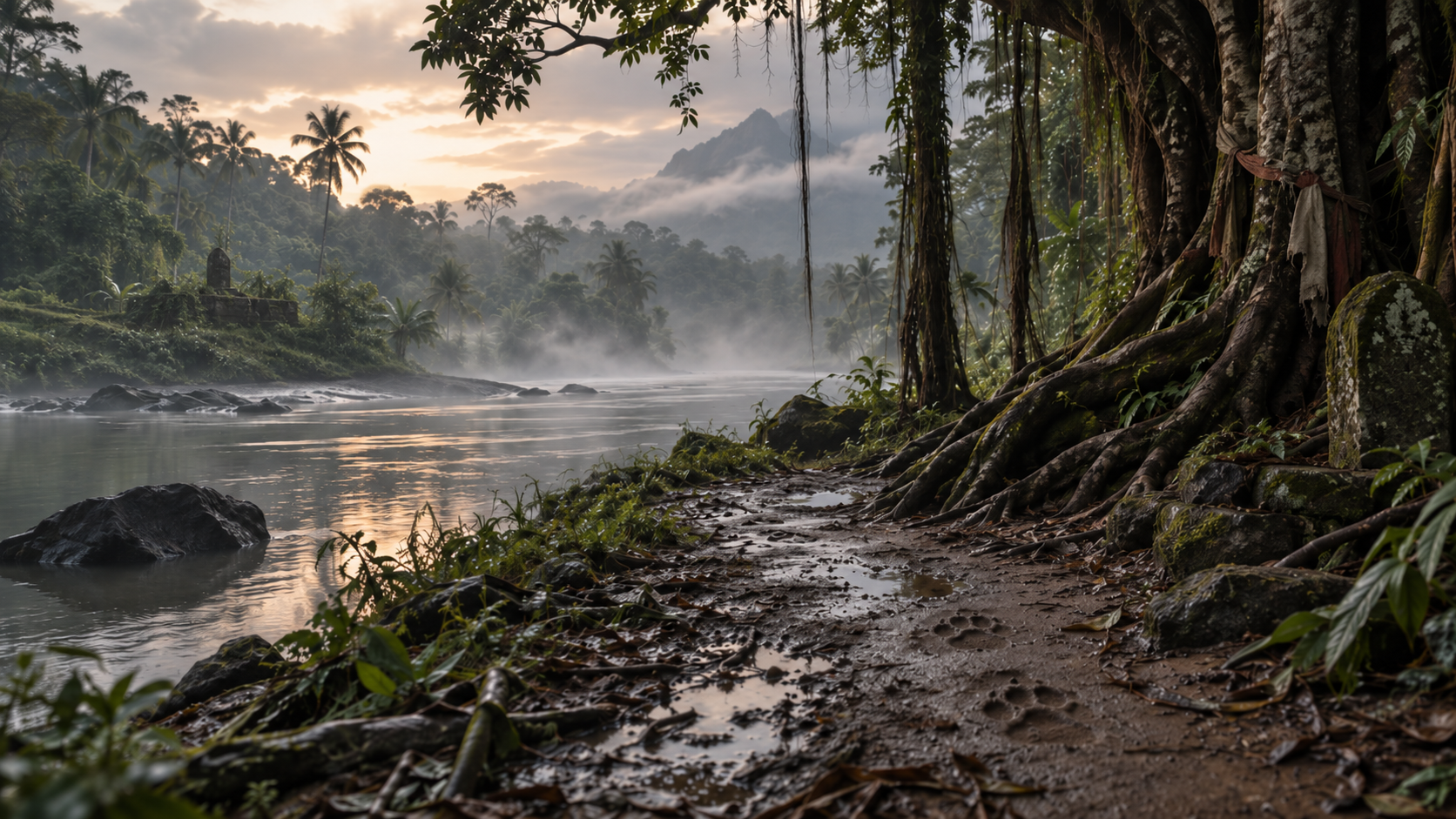
Nusantara history cannot be separated neatly from myth. Sacred mountains, guardian animals, haunted rivers, ancestral figures, miraculous rulers and stories of beings beyond ordinary human life appear repeatedly across the traditions of the region. Dark Nusantara does not want to remove that layer. But neither does it treat every mythic tradition as literal historical evidence. Instead, myth is approached as another form of memory.
A tiger can be an animal and still become a political symbol.
A dangerous bend in a river can accumulate stories over generations.
A sacred tree may mark territory, burial, ancestry or fear long before anyone writes down why.
A spirit story may preserve the emotional memory of violence even when the historical event itself becomes difficult to recover.
The novels therefore allow characters to believe. A healer may interpret something differently from a court jurist. A river community may preserve a warning that palace officials dismiss. A ruler may use genealogy and ritual to strengthen authority. None of those perspectives automatically becomes the narrator's final truth. This allows the mythic world to remain present without turning Nusantara history into generic supernatural fantasy. The aim is not to prove or disprove every legend.It is to understand why people carried those stories—and what those stories allowed them to remember.
Why I Started This
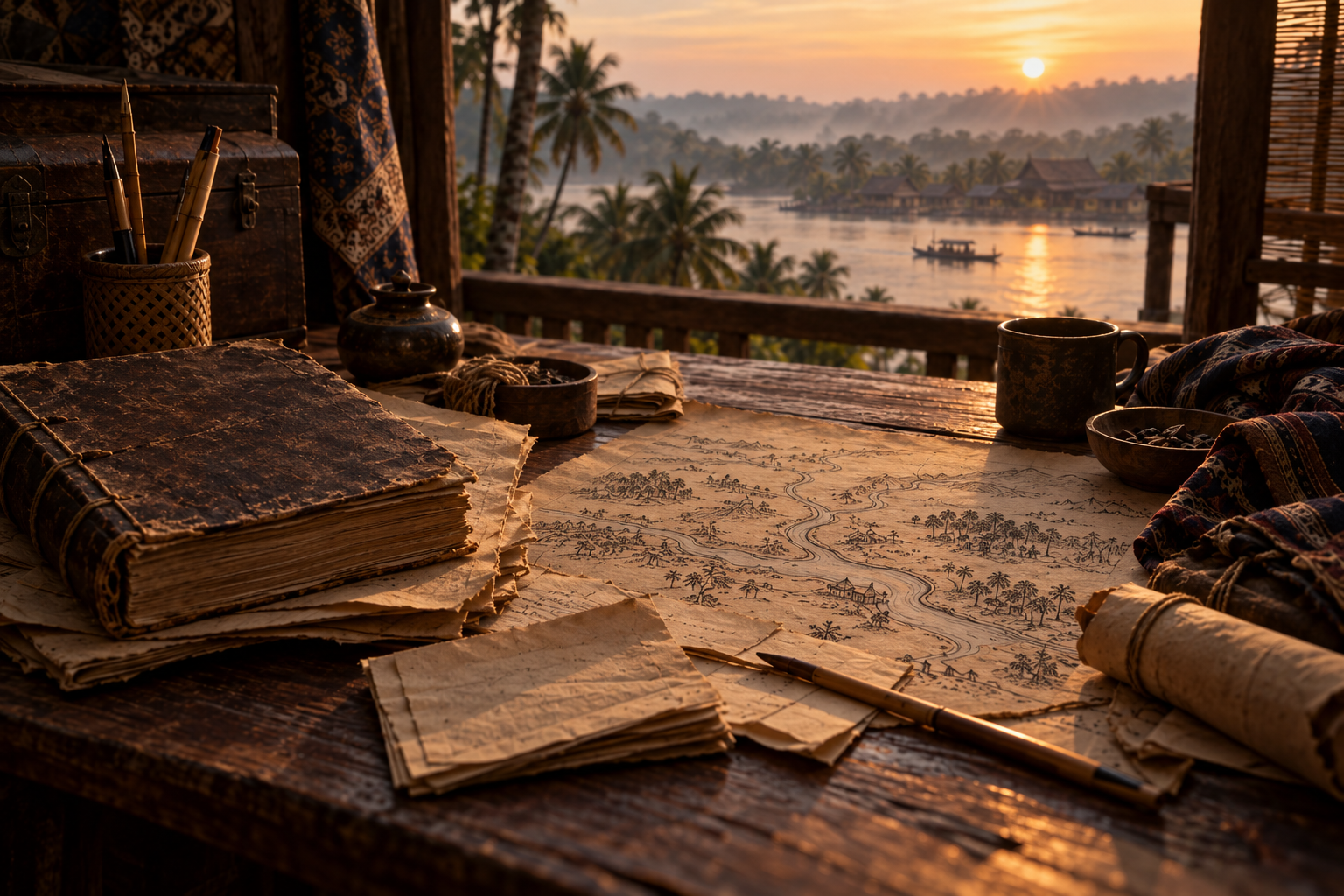
My own path into this began long before Dark Nusantara had a name. It began with a book. Growing up, I was fascinated by Siri Bercakap Dengan Jin, the long-running Malay series by Tamar Jalis. I first encountered it as a world of strange journeys, local histories, supernatural encounters and stories carried by people who seemed to move through a Malaysia that was both familiar and much older than the one around me. One storyline stayed with me more than the others. It involved an expedition into Perak and references to an ancient kingdom called Gangga Nagara. I remember the effect more clearly than I remember every detail of the story.The jungle in the book seemed to open for a moment. Behind modern Perak appeared another landscape: an older kingdom, a lost court, warriors, rivers and memories of invasion.
And suddenly I had a question.Was Gangga Nagara real?
That question never completely went away.Years later, when I began reading more seriously about the Chola campaigns of the eleventh century, the old curiosity returned in a different form. The historical record was both more fascinating and less complete than the stories I had imagined.Rajendra Chola I's maritime campaign was real. The great trading world connecting South India, the Malay Peninsula and the Straits was real. The political centres of early Nusantara were real. But the exact shape of many of those societies remains difficult to reconstruct.
That gap pulled me in.At first I wanted to know what happened to Gangga Nagara.Then the questions multiplied.What would the settlement have looked like? Who forged its weapons?What did its women inherit? How did ordinary families experience war? Where did survivors go after a kingdom fell? What knowledge travelled with them?What if the disappearance of a kingdom from formal history did not mean the disappearance of its people? Those questions eventually became Lost Thrones of Nusantara.
The novels are fiction.But the curiosity beneath them is real. Dark Nusantara exists so the two journeys can sit beside one another: the attempt to understand what history can actually tell us, and the attempt to imagine responsibly what life might have existed inside the silences.The project began with Gangga Nagara.It has since become much larger.But I still think of that first question whenever I begin a new kingdom: What was really here—and how much of it have we forgotten?
What You'll Find Here
Dark Nusantara brings together:historical essays on early Nusantara kingdoms, trade, warfare and material culture;investigations into legends, chronicles and contested histories;visual reconstructions of settlements, clothing, landscapes and daily life;behind-the-scenes worldbuilding from Lost Thrones of Nusantara; character, location and cultural dossiers;and reflections on how fragmentary history becomes historical fiction without disguising invention as fact.The boundary between history, tradition, reconstruction and fiction will remain visible throughout.
Enter Dark Nusantara
Start with the history. Follow the forgotten kingdoms. Then step into the reconstructed world.